A CRM your reps don't have to feed.
The pipeline updates itself from real activity, an AI SDR works every lead in the queue until it books or dies, and your forecast rolls up from evidence — emails, calls and meetings — instead of what a rep remembered to type on Friday.
Q4 pipeline · 13 open deals
LiveQualified 6
Proposal 4
Won 3
Median change in the first two quarters, measured against each team's own 30-day pre-migration baseline.
Everything a sales team does, minus the typing.
Six capabilities run on one data model, one scoring engine and one activity log — so the number your board sees is the number the rep sees, refreshed to the minute.
Lead scoring & routing
Fit and intent scored on 40+ signals — tech stack, hiring velocity, funding, pricing-page visits — then routed by territory, segment and rep capacity in under ten seconds.
AI SDR outreach
Researches the account, writes the first line, sends from a warmed domain, handles the reply and books into the rep's calendar — around the clock, in 11 languages.
Pipeline management
Stages that move when evidence moves: idle deals flagged past your threshold, next steps proposed from what worked before, and a snapshot taken every night at 18:00.
Email & sequence automation
Multi-channel cadences across email, call, LinkedIn and manual tasks — with per-contact send-time optimisation, spam checks and domain warm-up limits built in.
Call & meeting intelligence
Every call recorded, transcribed and summarised — objections, competitors and commitments extracted automatically and written back to the deal record with timestamps.
Forecasting & revenue analytics
Commit, best case and pipeline per rep — rolled up from stage probability, activity evidence and your own historical conversion, refreshed nightly and defensible line by line.
An SDR that works every lead. All of them.
Not a chatbot bolted to a form. A researcher, writer and booker that runs your top-of-funnel the way your best rep would — if your best rep had forty hours a day.
- Researches the account before writing. Funding round, warehouse opening, new VP on LinkedIn, tech migration — it picks the trigger a human would have found in 15 minutes.
- Personalises from real triggers, not mail-merge. Every first line says something specific about the prospect's business. No "I came across your website" filler.
- Books straight into the rep's calendar. Reads availability, offers three slots, confirms the invite and drops a briefing on the record before the call.
- Stops the moment a human replies. Any live reply, objection or unsubscribe halts the sequence in under a second and hands the thread to the owner.
Four stages. One system that works them.
Prospect, engage, close, forecast — each stage has its own surface, its own automation and the same underlying record. Nothing is rekeyed between them.
Score the queue before a rep opens it.
Every new lead is enriched, scored against your closed-won history and routed in seconds — so the first touch lands while the intent is still warm.
- 40+ scoring signals recalculated after every page view, reply and firmographic change.
- Routing by territory, segment and capacity — round-robin that respects who is actually on a call.
- Duplicate and spam detection before anything reaches a sequence or a dashboard.
- Warm leads resurface when a trigger fires: job change, pricing visit, hiring spike.
Sequences that read the room.
Cadences mix email, call, LinkedIn and tasks — and rewrite themselves the moment a prospect's behaviour changes the odds of a reply.
- Trigger-based steps fire on events — a pricing-page visit, an email open — not on a fixed calendar.
- Send-time optimisation per contact and timezone, learned from every delivered message.
- Deliverability guard — warm-up limits, spam-word checks and per-domain health scoring.
- Reply detection parses sentiment and intent, then hands the thread to the rep with a suggested answer.
The deal room with nothing missing.
Redlines, stakeholders, blockers and next steps live on the record because they were captured as they happened — not reconstructed the night before the call.
- Mutual action plans with dates the buyer actually agreed to, tracked against the signature deadline.
- Automatic stakeholder map built from the email and meeting graph — including the people who never reply.
- Idle-deal prompts fire when nothing has moved in three days, with a next action drawn from similar wins.
- Quotes and order forms generated from the record, priced inside your approval rules, signed in the browser.
A number you can defend.
The forecast rolls up from stage probability, activity evidence and your own historical conversion — every deal carries the reason behind its confidence.
- Commit, best case and pipeline per rep and segment, refreshed nightly at 18:00.
- Slippage alerts flagged 14 days out, when there is still time to do something about it.
- Evidence trail — which deals changed this week, and exactly what changed them.
- Board-ready export — variance against plan, coverage ratios and win-rate trend in one click.
What it looks like in daily use.
Not mockups — production screenshots from a live BytesFusion deployment, where the front desk runs customer records, inquiries and follow-ups on this CRM every day.
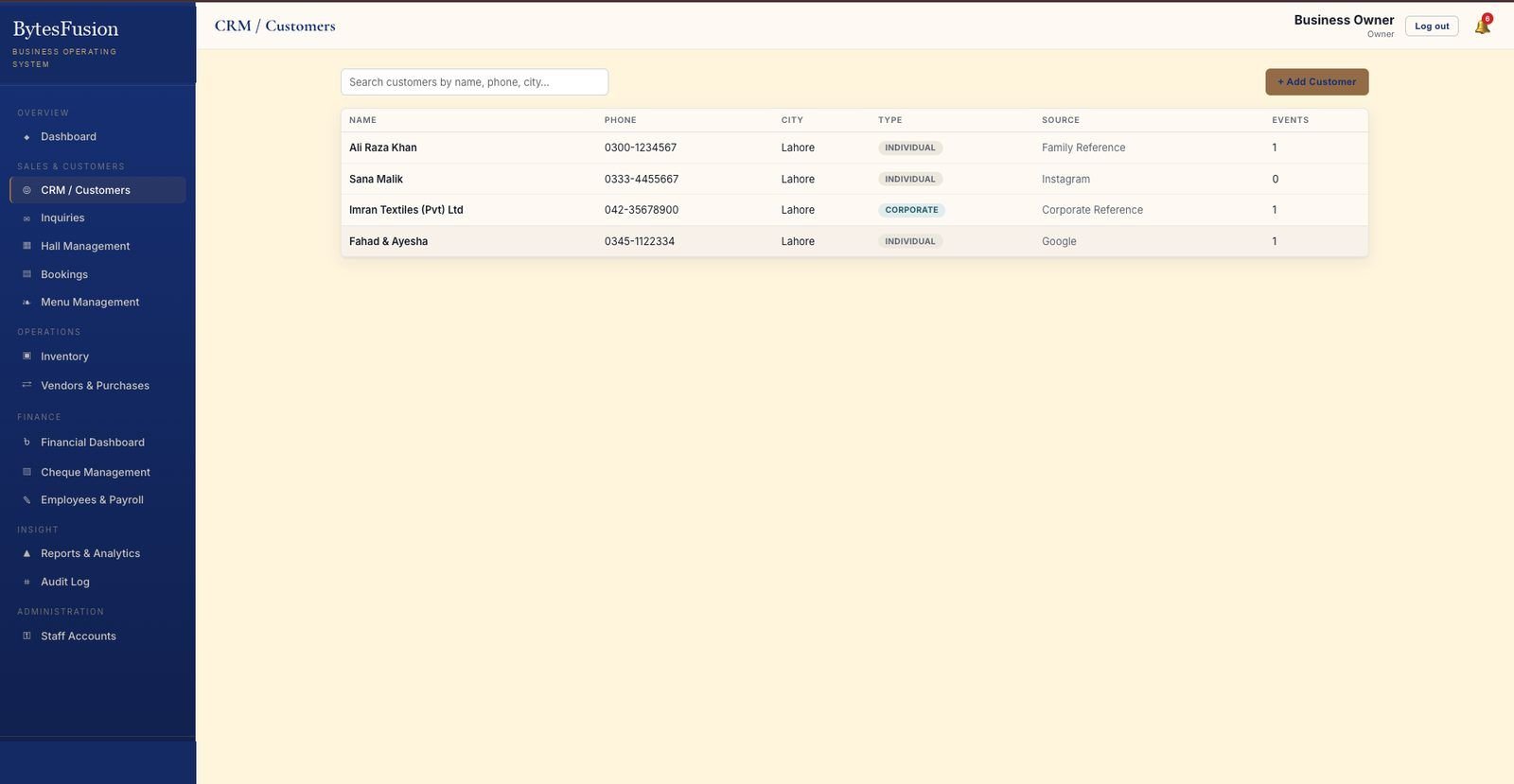 Customer recordsContact details, city, type, source and follow-up status — one searchable table the whole team shares.
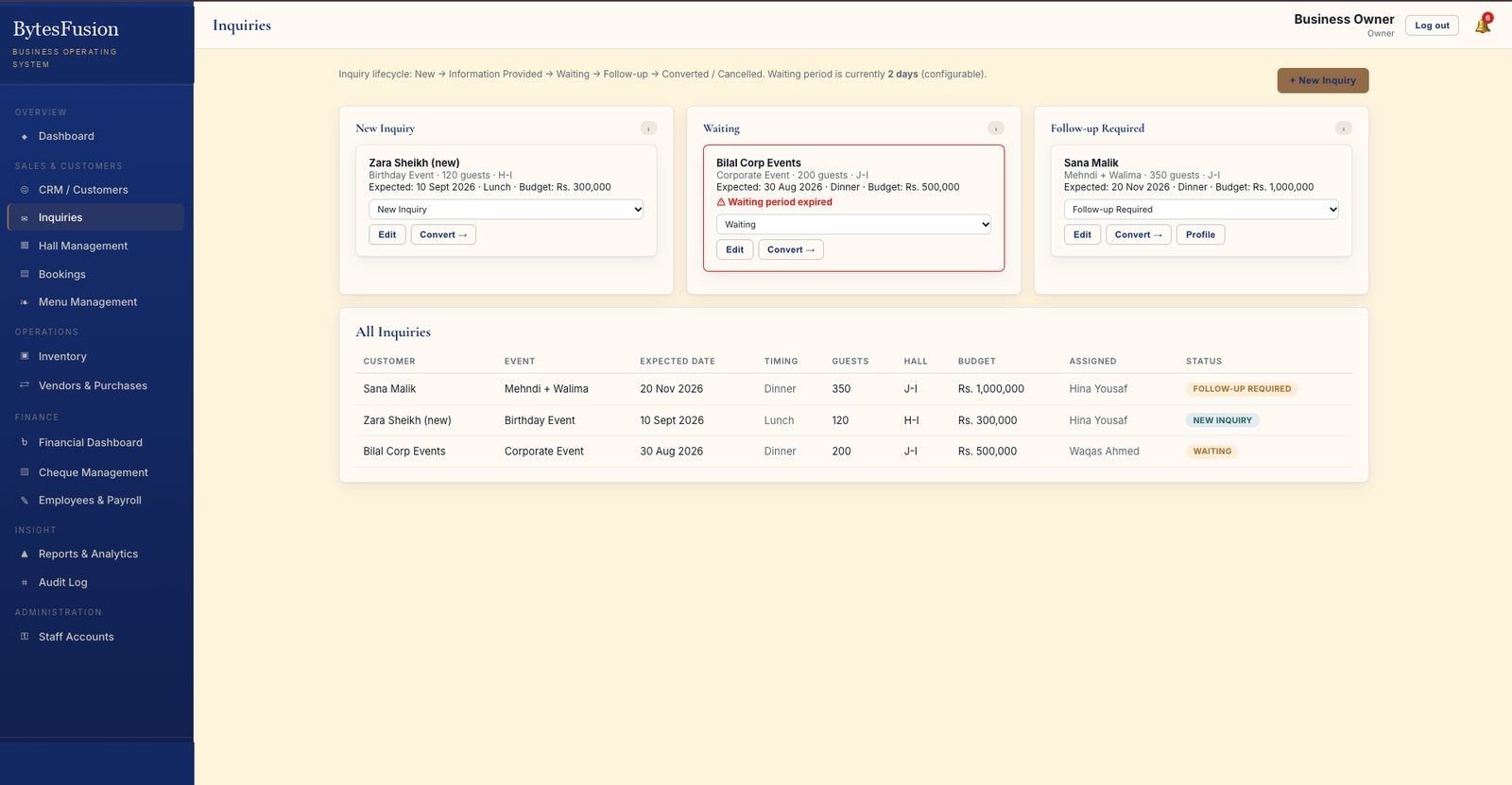 Inquiry pipelineEvery lead captured with event details, budget and an assigned employee — nothing sits unclaimed.
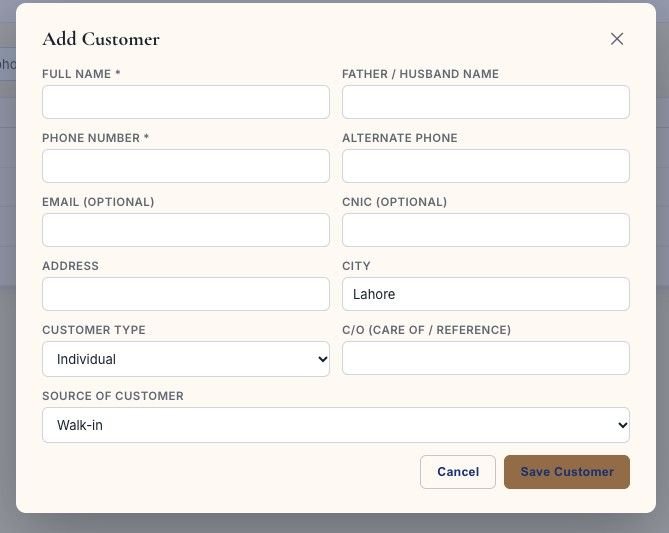 Fifteen-second captureThe add-customer form: type, city, reference and source of customer, filled at the front desk.
These screens come from the ERP deployment→ — the CRM is one module of it, and both share the same customer records.
Nobody updates this CRM. It updates itself.
Email, calls, meetings and contact changes are captured at the source, matched to the right record and summarised. 98% of activity lands without a single form field being opened — which is also why the forecast can be trusted.
What changes in the first two quarters.
Measured across 26 deployments between 4 and 18 months after go-live, against each team's own pre-migration baseline.
Meetings booked
Reps hold 41% more calendar meetings per month because the AI SDR works every lead in the queue — not only the ones whose logo a rep recognises.
Cost per opportunity
Sequences, enrichment and dialer minutes are bundled into one line, so the blended cost of producing an opportunity falls by a third within two quarters.
Activity captured
With email, calls and meetings logged automatically, 98% of real activity reaches the record — so the forecast is built on what happened, not on what got typed in.
Baselines are each team's own 30 days before migration; figures shown are medians across deployments, not best outliers.
Your pipeline is not our training data.
The controls your security team asks about in the first call — documented, contractual and already running for the other 180 systems we've shipped.
GDPR-ready handling
EU or US residency, per-record retention rules, one-click export and hard delete. DPA and Article 28 processor terms ready before signature.
Role-based permissions
Row-, field- and record-level roles enforced on the server: reps see their patch, managers see the team, finance sees the numbers — never the other way round.
SOC 2-aligned processes
Change management, access reviews, vendor risk and incident response run to a SOC 2-aligned control set, with evidence collected continuously rather than at audit time.
Never used for training
Contractual no-training terms with every model provider. Prompts stay in your region, PII is redacted before inference, and you can bring your own keys.
Security questionnaire, architecture diagram and penetration test summary available before the first call — ask and we'll send them.
What clients say about the CRM.
"The AI agent automated our lead generation process, finding, qualifying, and organizing potential customers so our sales team could focus on closing deals."
What sales leaders ask us first.
Most teams are fully cut over in 8–14 days. We map objects, custom fields and record types, import historical activity and open opportunities, then run both systems in parallel for a week while sequences keep sending. On cutover the old instance becomes a read-only archive, so nothing is lost and nobody works a dark week.
It writes from your win reasons, your case studies and a researched trigger — not a template with a merge tag in it. Every draft sits in a review queue before it sends, so you can edit or reject it; replies that read as human hand off instantly, and negative sentiment or an unsubscribe stops the sequence within a second. Most teams are approving eight of every ten drafts untouched by the end of the second fortnight.
You do. Your records, transcripts and sequences are yours alone, encrypted in transit and at rest, and never used to train third-party models — ours or anyone else's. You can export everything as JSON and CSV at any time, and on the last day of the contract we hard-delete from production and backups within 30 days, with written confirmation.
Native connectors authenticate over OAuth and subscribe to webhooks, so a reply in Gmail or a stage change in Salesforce reaches the record in under two seconds — both directions, with field-level conflict rules so nobody's edit is silently overwritten. Anything not on the list is a short job against the REST API and signed webhooks; it is the same API our interface uses, with the same rate limits and audit trail.
Your choice. The platform is priced per seat, and the AI SDR can run per seat, per meeting booked, or as a fixed monthly outcome bundle with a guaranteed floor. Most teams start per seat, move the SDR to per-meeting after the first quarter once the baseline is clear, and finish paying less per opportunity than the stack they replaced.
Still weighing it up? See per-seat and per-outcome pricing→
Put an AI SDR on your pipeline this quarter.
Bring one segment of your list. We'll score it, draft the first sequence and show you the meetings it would book — on your data, in one call, no deck.